

 English

 Español
 中文简体

Content
- 1 What Makes a PET Fruit Tray Count as Shallow?
- 2 Depth and Format Ranges for Shallow PET Fruit Trays
- 3 Shallow Versus Deep PET Fruit Trays
- 4 What a Shallow Tray Can Carry: PET Gauge and Visual Quality
- 5 Shallow PET Fruit Tray Procurement Checklist
- 6 Stacking, Nesting and Export Packing Notes
- 7 Shallow PET Fruit Tray FAQ
A shallow PET fruit tray is a formed tray roughly 15 to 30 mm deep, chosen so the fruit sits on the tray rather than in it. Buyers who specify this depth are usually chasing two things at once: product that looks fuller on the shelf, and a rim that stretch film can pull tight against. Everything else in the specification sheet, from sheet gauge to base pattern, follows from those two requirements.
Problems show up late, not early. A brand approves a deep tray, sees the shelf mock-up, asks for something shallower, and by the third revision the rim width, base ribbing and carton height have all drifted. The quotation no longer matches the drawing, and nobody can say which version was costed.
What Makes a PET Fruit Tray Count as Shallow?
A tray counts as shallow when its internal depth stays under roughly 30 mm and the rim still lets the top of the fruit sit above the edge.
A shallow PET fruit tray is a thermoformed PET tray with low sidewalls, typically between 15 and 30 mm deep, finished with a flared rim that accepts stretch film or a snap lid. Its job is to maximise exposed product surface rather than to increase carrying volume.
Below that band the tray turns into a flat platter, with almost no protection against roll. Above it, the same footprint loses usable flat area as the sidewalls climb, and the fruit begins to disappear into the container. The visual difference between a 20 mm and a 35 mm tray in a single photograph is larger than the numbers suggest.
- Depth: 15 to 30 mm covers most retail shallow trays, from single-serve punnets to catering platters.
- Sidewall draft: usually 8 to 15 degrees, which keeps the tray stackable while still releasing cleanly from the mould.
- Rim: a flared edge with a short inward return of 3 to 5 mm, giving stretch film a lip to grip.
- Base: flat or lightly recessed, so the weight of the fruit lands on the base rather than loading the sidewalls.
Depth and Format Ranges for Shallow PET Fruit Trays
Shallow trays generally run 15 to 30 mm deep across formats from about 135 x 90 mm single-serve sizes up to catering platters beyond 300 mm.
Depth and footprint only make sense together. A 20 mm tray at 135 mm wide handles blueberries comfortably, but the same depth filled with halved kiwi leaves the fruit standing almost level with the rim, and the protection the depth was supposed to buy is gone. Test samples with the fruit you actually pack, not with a close relative of it.
| Depth reference | Common footprint | Fruit that fits comfortably |
| 12-15 mm | 135 x 90 mm | Berries, cherries, single-portion fresh cuts |
| 15-20 mm | 180 x 120 mm | Grapes, small stone fruit, mushroom display |
| 20-25 mm | 220 x 150 mm | Strawberries, plums, mixed fresh-cut blends |
| 25-30 mm | 280 x 180 mm and above | Catering platters, gift combinations, large fruit |
Tinted and gold shallow trays are standard in catering formats. At the same 220 mm footprint, a clear tray sells the fruit and a gold tray sells the arrangement, which is why wider shallow trays usually carry a reinforced sidewall: the larger the tray, the faster the rim gives way under stacked weight.
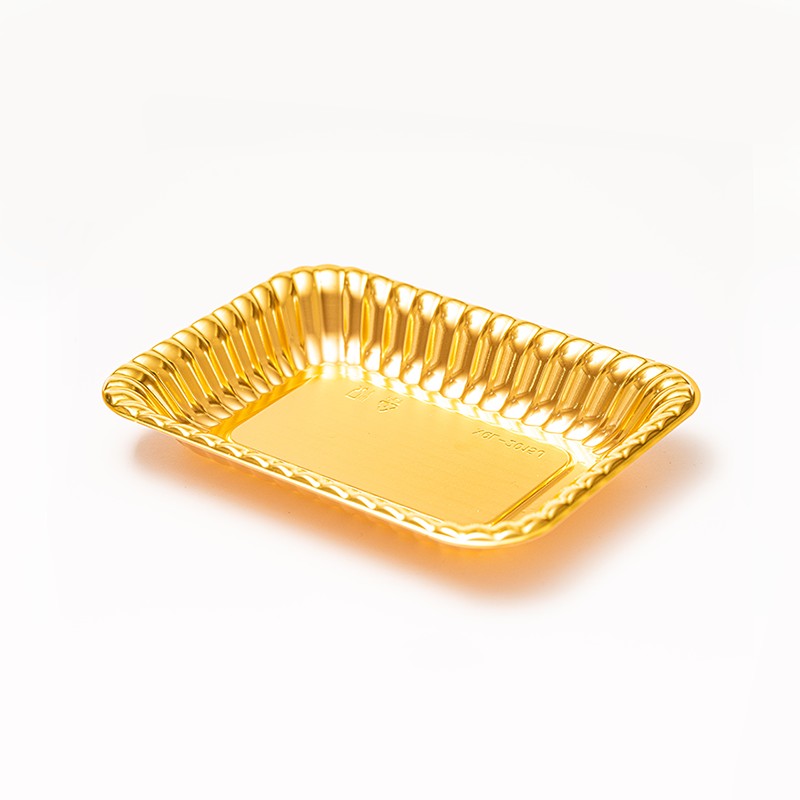
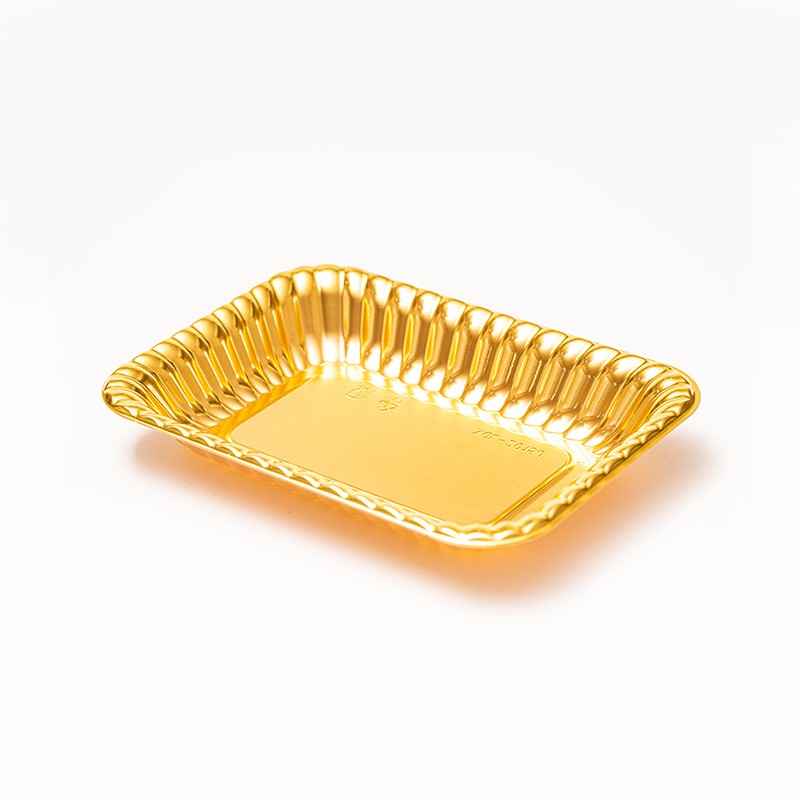 Gold PET Shallow Fruit Tray with Reinforced SidesThis 15 g gold PET tray measures 200 × 145 × 25 mm and uses side reinforcement ribs to support a shallow, visible premium fruit display with cling-film sealing.View Product →
Shallow Versus Deep PET Fruit Trays
Shallow trays win on visibility and film performance; deep trays win on load volume and long-haul protection.
- Fruit surface stays fully visible to the shopper
- Less PET sheet consumed per tray
- Flatter lidded profile, so cartons stack cleanly
- Better fit for mixed retail and gift assortments
- Greater loaded volume per tray
- Better containment for tall or mounded fruit
- More cushioning across long distribution routes
- Preferred for buffet and food-service prep
The deciding trade-off is usually freight, not production. A shallow tray adds two more layers per carton, which can mean several hundred extra cartons per load; if that load travels 800 km with a transfer in between, the extra density rarely pays for the damage. Size the route before sizing the depth.
There is also a merchandising angle that rarely makes it into the specification. Shallow trays photograph flatter, which suits retailers that sell by tray or by gift set. Where the channel sells strictly by weight, the tray contributes nothing to the price the shopper sees, and depth should be chosen purely on protection.
What a Shallow Tray Can Carry: PET Gauge and Visual Quality
A shallow tray's strength comes from sheet gauge combined with corner radius, not from added wall thickness alone.
PET gives food packaging its clarity and stiffness, which also makes a shallow tray unusually sensitive to surface quality. Scratches, haze and stress whitening all read louder on a low tray because the viewing angle grazes the surface. During incoming inspection, look at the corners and rim first: stress whitening tells you more about moulding stability than an overall gauge measurement does.
- Sheet gauge: retail shallow trays use a wide range, and adding gauge stiffens the rim at a small cost in clarity.
- Heat tolerance: PET softens in the 60 to 70 degree range, so hot bakes and warmed foods do not belong in a shallow tray.
- Clarity: lower crystallinity reads clearer at the same thickness, while unstable forming temperatures cause batch-to-batch colour drift.
- Rim return: too shallow and the film will not hold; too deep and nested trays jam together on the line.
An arched base changes the fill effect as well. The same weight of fruit reads as more when the base lifts it slightly, which matters for tray-sold and gift-sold channels and does nothing at all for weight-sold channels.
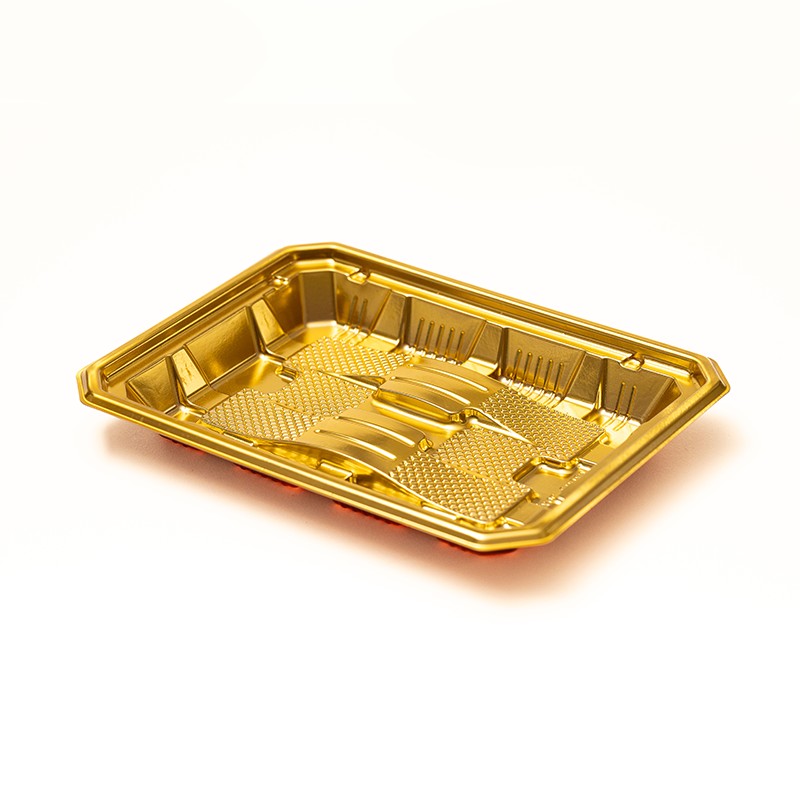
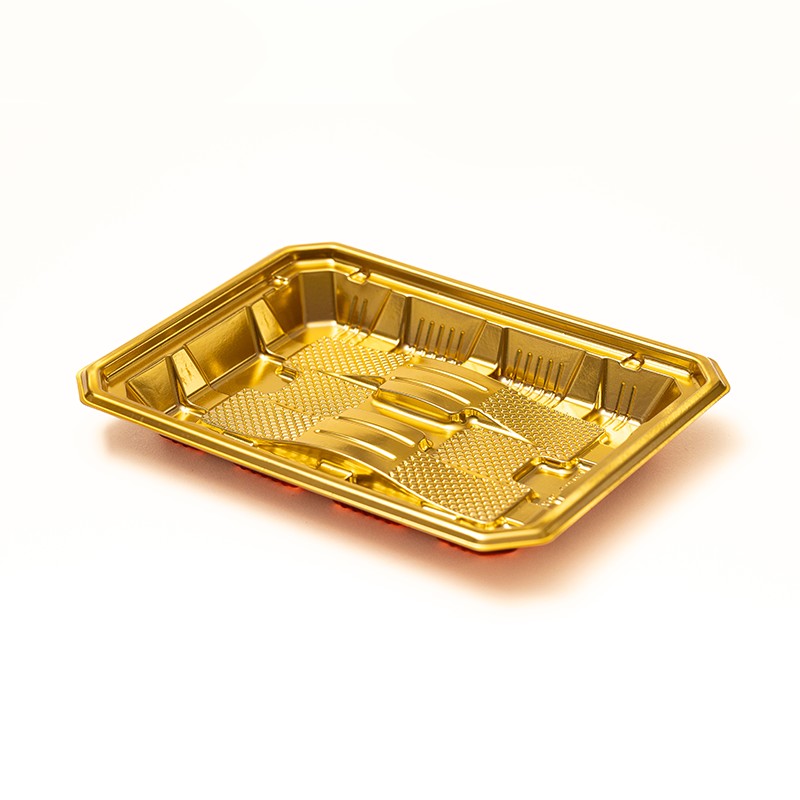 Gold PET Shallow Tray with Arched BaseThis 20 g gold PET tray measures 210 × 160 × 25 mm; its arched base and side ribs support a fuller-looking premium fruit or food presentation for gift and retail formats.View Product →
Shallow PET Fruit Tray Procurement Checklist
Most shallow tray failures trace back to five specifications that never made it onto the drawing.
Three details get lost between approved sample and mass production: sheet gauge, rim return depth, and nested stack height. Change any one of them and both the shelf appearance and the carton count move, while the sample photograph looks identical.
- Put the depth on the drawing. Write "shallow" out of the conversation and specify internal depth with a tolerance band instead.
- Fix the sheet gauge in the purchase contract. The same mould running a thinner sheet changes both stiffness and film behaviour.
- Confirm the rim return depth, and ask whether the film seals above or below the return. Wrapping machines care about millimetres here.
- Measure the real nested stack height. Shallow trays nest differently from deep ones, so carton dimensions have to be recalculated.
- Agree the seal width after wrapping. Rim width drives the sealing parameters, and this is the item most often mismatched when a supplier changes.
Buyers who want the wider specification context, including format families and incoming inspection points, will find it in this PET food tray sourcing guide.
Stacking, Nesting and Export Packing Notes
Shallow trays stack flatter than deep trays, which also makes them easier to shift inside a carton unless the packing is designed for it.
The most common export complaint on shallow trays is not crushing. It is rim distortion. The sidewalls are short, so a divider that presses hard against the rim tips the whole tray sideways, and once a container goes through a temperature swing, that tilt tends to stay.
- Nesting ratio: shallow trays overlap more than deep trays, so calculate carton fill from measured nested height rather than from nominal tray depth.
- Film tension: over-tensioned film pinches the two long sides inward, and the fruit in the middle lifts the film from underneath.
- Carton compression: the rims carry most of the stacking load, so soft corrugated grades defeat the purpose of a reinforced tray.
- Humidity and temperature swings: PET dimensions shift slightly across a sea freight cycle, and allowing for it costs less than a rework claim.
Anti-cut and reinforced shallow formats exist for a reason. Fresh fruit with firm stems or trimmed crowns will score a plain sheet within a day, and a tray that carries a protective film or a thicker base survives retail handling with far fewer rejects.
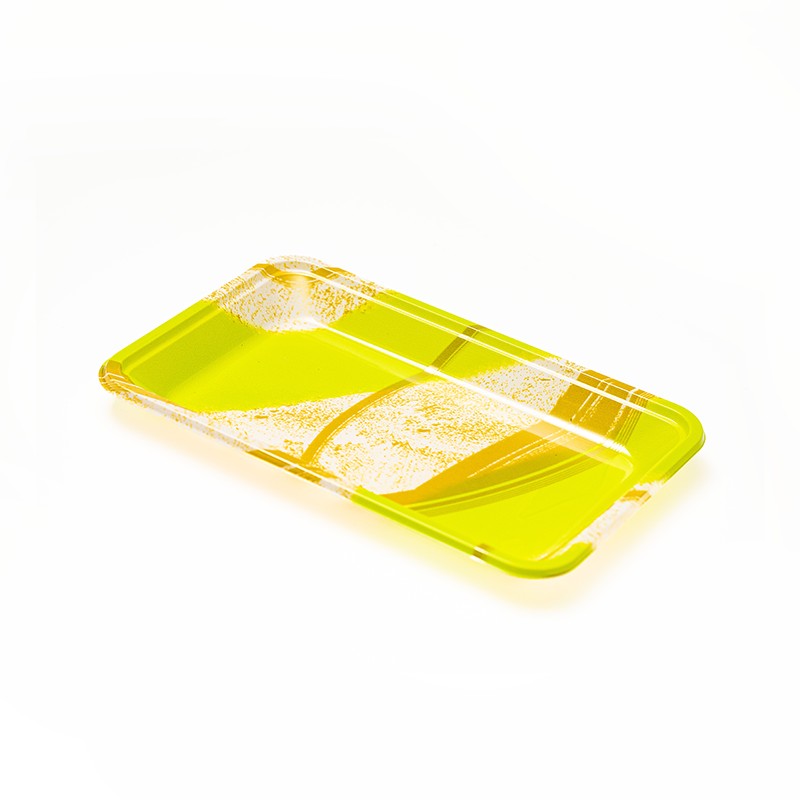
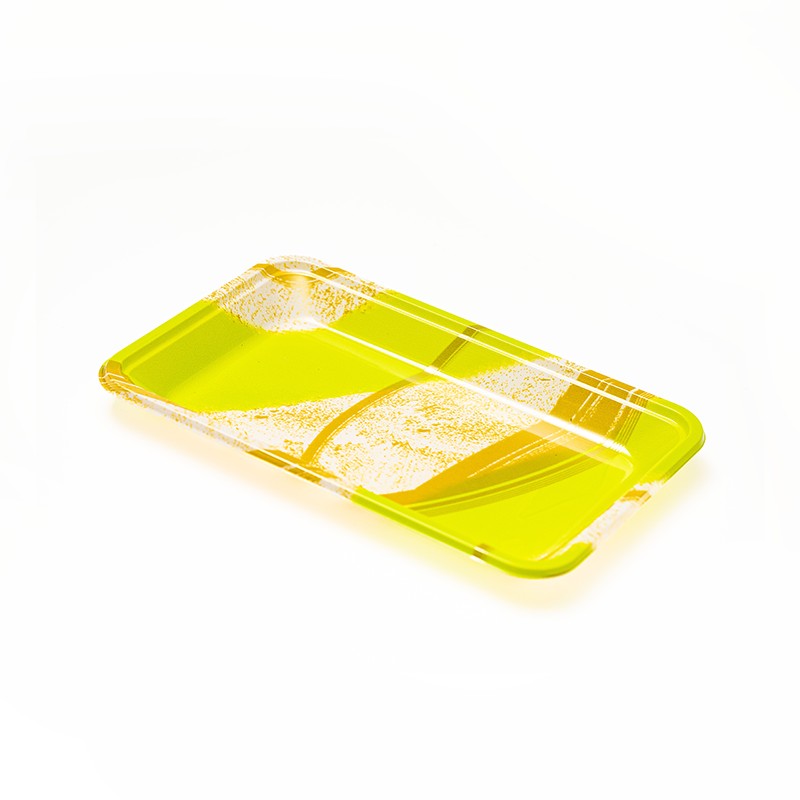 Green Film PET Shallow Anti-Cut Fruit TrayThis 13 g green-film PET tray has an anti-cut reinforced edge and shallow visible profile, sized 200 × 130 × 18 mm for fruit display.View Product →
Shallow PET Fruit Tray FAQ
How deep is a shallow PET fruit tray usually?
Retail shallow trays most often sit between 15 and 30 mm deep. Anything under 15 mm behaves more like a flat platter and suits single-serve berries or sampling portions, while anything over 30 mm generally falls into the deep tray category.
Can shallow PET trays run on an automatic wrapping line?
Yes, provided the rim has enough return width for the film to grip. Narrow-rim shallow trays seal poorly on high-speed lines, especially where the rim has been tinted or coated, so confirm the seal zone before committing to a line speed.
Are shallow PET fruit trays food grade?
Food-grade PET is made for direct fruit contact. The reliable way to confirm it is a material specification sheet plus migration test documentation rather than a marketing claim, and thin-wall shallow trays deserve closer scrutiny because any additive issue shows up more directly in a light container.
Where does the cost difference between shallow and deep trays sit?
Mostly in sheet consumption and carton density. A shallow tray uses less material per unit but packs in higher counts, and the real comparison is packaging cost per kilo of fruit across the whole chain rather than the unit price of one tray.