

 English

 Español
  中文简体
中文简体

Content
- 1 What a PETG Heat Seal Food Container Actually Is
- 2 Heat Seal Parameters That Decide Whether a Tray Leaks
- 3 Where Sealed PETG Earns Its Cost: Modified Atmosphere Packaging
- 4 Container Structure: What to Write Into the Specification
- 5 Sealed Tray or Lidded Tray: Choosing Deliberately
- 6 Validating a Sealed Tray in Five Steps
- 7 Frequently Asked Questions
A tray that loses its seal in transit converts a controlled atmosphere pack into an ordinary box. That single failure mode is why fresh-cut produce, cooked deli, and raw meat processors converge on the same specification: a PETG heat seal food container.
A sealed food container is not one product. It is a system built from a thermoformed PETG tray or base, a seal layer on the lidding film, and the temperature curve on the sealing machine. When any one of those three is out of step with the others, the seal fails at the flange, and the flange is the only part of the pack that proves whether the design works.
What follows is what actually matters when you specify, quote, or validate a sealed PETG format, and how each variable shows up on the pallet you receive.
What a PETG Heat Seal Food Container Actually Is
A PETG heat seal food container is a rigid pack made from glycol-modified PET sheet, thermoformed into a tray or base, then closed with a coated lidding film welded to the container flange under heat and pressure. The weld forms the gas barrier; the PETG body supplies clarity, stiffness, and resistance to cracking.
One point trips up a lot of buyers. The PETG tray does not melt to form the seal. The bond happens inside the seal layer of the film, usually a polyethylene or coextruded PE and EVA coating that softens and fuses to the flange. That is why the same tray behaves completely differently when you change the lidding film.
PET, PETG, and PP Compared for Sealed Trays
| Property | Standard PET | PETG | PP |
| Optical clarity | High | Very high | Moderate |
| Drop and crack resistance | Moderate | High | High |
| Thermoforming window | Narrow | Wide | Wide |
| Seal layer compatibility | Needs coating or coextrusion | Works with common seal lacquers and coextruded films | Requires a PP-based seal layer |
| Performance at low temperature | Limited without modification | Moderate | High |
| Typical use | Fruit clamshells and cups | MAP trays for fresh-cut and prepared food | Deli and frozen meat trays |
Heat Seal Parameters That Decide Whether a Tray Leaks
Three variables control the weld: platen temperature, dwell time, and seal pressure. Get all three inside the window and peel strength stays consistent around the whole flange. Miss any one of them and failures cluster at the corners, where the film has to stretch over the radius.
Too cool, and the seal layer never wets out against the flange. You get what the industry calls a cold seal: it looks correct on the line and leaks on the pallet. Too hot, and the film puckers, stretches, or burns through at the edge.
Dwell time and pressure compensate for each other, which is exactly what makes them dangerous to adjust. A sealing machine running high pressure can sometimes hold a shorter dwell, but the film thins under compression and peel strength drops. During validation, treat temperature as the primary variable and hold the other two steady.
Flange geometry is set by the forming tool, not by the material, so it is worth reviewing the manufacturing setup before you commit to tooling for a new format.
Where Sealed PETG Earns Its Cost: Modified Atmosphere Packaging
Modified atmosphere packaging replaces the air inside a sealed tray with a controlled gas mix, and the seal is the only thing holding that mix in place. PETG gets specified when the product needs both a fully visible pack and a shelf life measured in days rather than hours.
Starting gas mixes vary by product category, and these ranges are where most validation work begins:
- Fresh-cut leafy greens: roughly 3 to 5 percent oxygen, 5 to 10 percent carbon dioxide, balance nitrogen
- Fresh-cut fruit: roughly 5 to 10 percent oxygen, 5 to 15 percent carbon dioxide, balance nitrogen
- Cooked and cured deli items: 20 to 30 percent carbon dioxide, no oxygen, balance nitrogen
- Raw red meat: a high-oxygen mix to hold the bloom, or a low-oxygen mix for a darker, longer-keeping pack
Mixed square-and-round formats are common in prepared food because they present well in the case while still stacking predictably on the line.
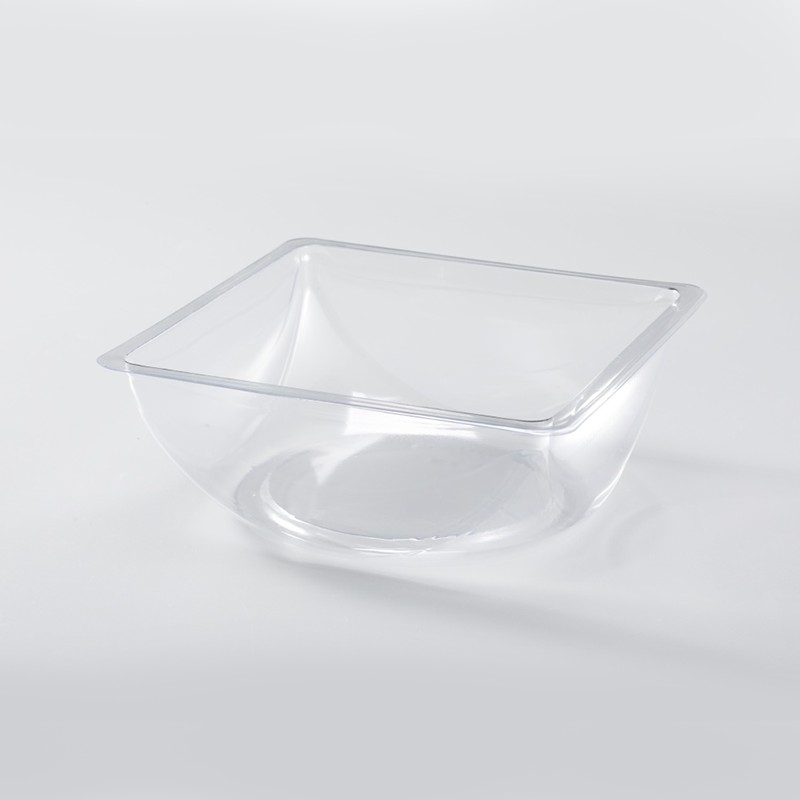
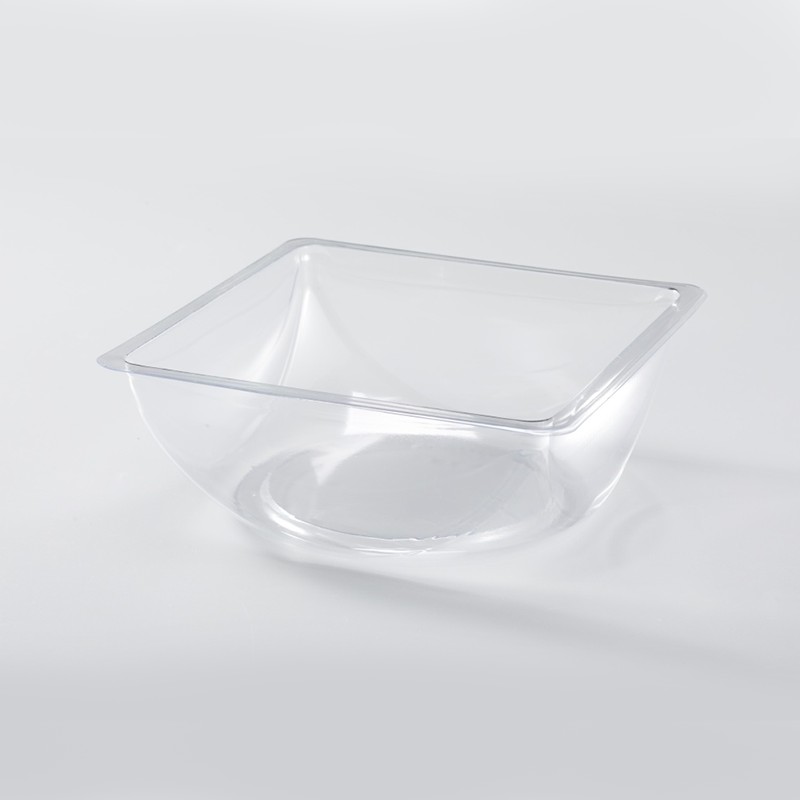 XGL-1818 PETG Heat Seal Square-Round Combo Food ContainerSquare-top, round-bottom GAG container for mixed prepared-food formats, offering high transparency and heat-seal compatibility for airtight transport and display.View Product →
Container Structure: What to Write Into the Specification
Wall and flange design matter as much as the polymer choice. Flange width, corner radius, and stacking geometry decide whether a sealed tray survives a pallet stack, a refrigerated case, and a delivery van without losing gas tightness.
- Flange width and flatness: a wider flange tolerates more seal variation but consumes more film per pack
- Corner radius: tight radii are harder to seal and harder to de-nest at line speed
- Sidewall reinforcement: ribbed or stepped walls resist bulging under gas pressure or vacuum
- Stacking lugs and auto-stack features: keep sealed packs aligned and stable through palletizing
- Base rigidity: a flat, stiff base stops handling stress from transferring up to the seal
High-speed lines and pallet stability are usually the two reasons a processor moves from a standard tray to a reinforced rectangular format with automatic stacking features.
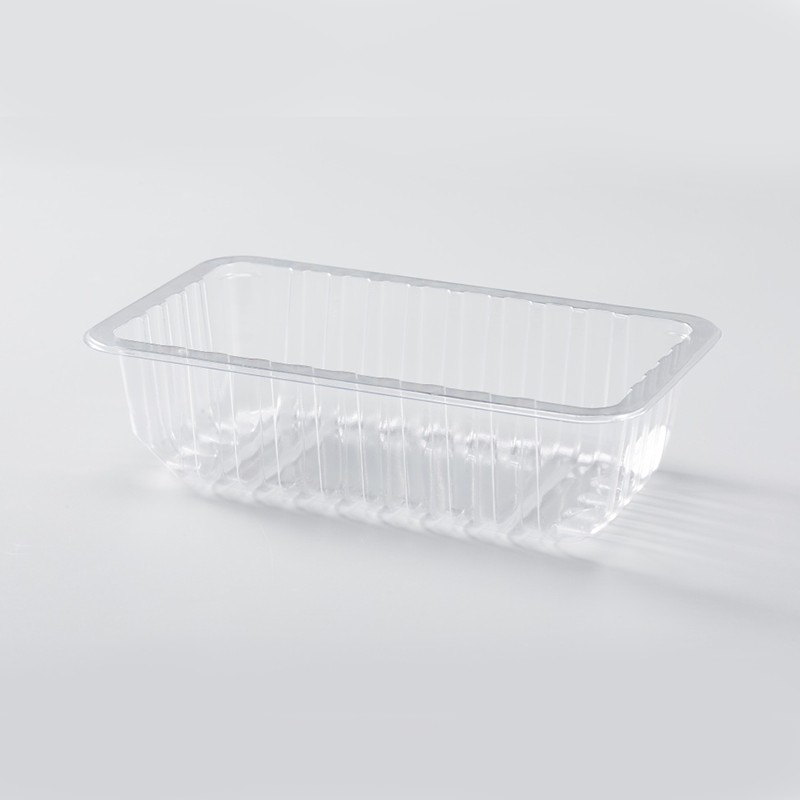
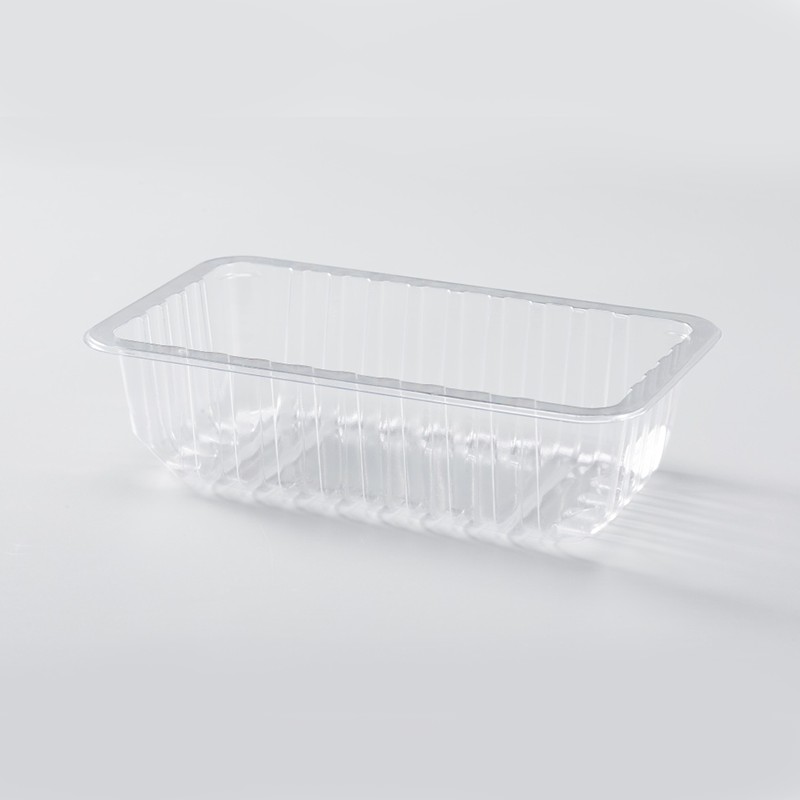 XGL-2213H6 PETG Heat Seal Reinforced Rectangular Auto-Stack ContainerReinforced rectangular GAG tray with corner stacking guides and stronger heat-seal bond, suited to automated lines needing pallet stability and gas-control packaging.View Product →
Sealed Tray or Lidded Tray: Choosing Deliberately
Heat sealing is not automatically the right answer. It wins when gas control matters. It loses when the pack has to be opened and reclosed on a shelf, or when the product needs to breathe.
Heat seal, PETG base
- Gas barrier across the whole flange
- Shelf life measured in days
- Highest clarity for retail display
- Requires matched film and sealing die
- Single-use opening
Snap lid, PET or PP base
- Reclosable, resealable in store
- No film consumption per pack
- Works with vented lids for hot product
- Lower barrier than a welded seal
- Shorter shelf life without MAP
Deli counters are the clearest example. When a pack gets opened and closed repeatedly during service, a lidded tray with an anti-fog clear cover is the more practical specification, and the seal is simply not the constraint.
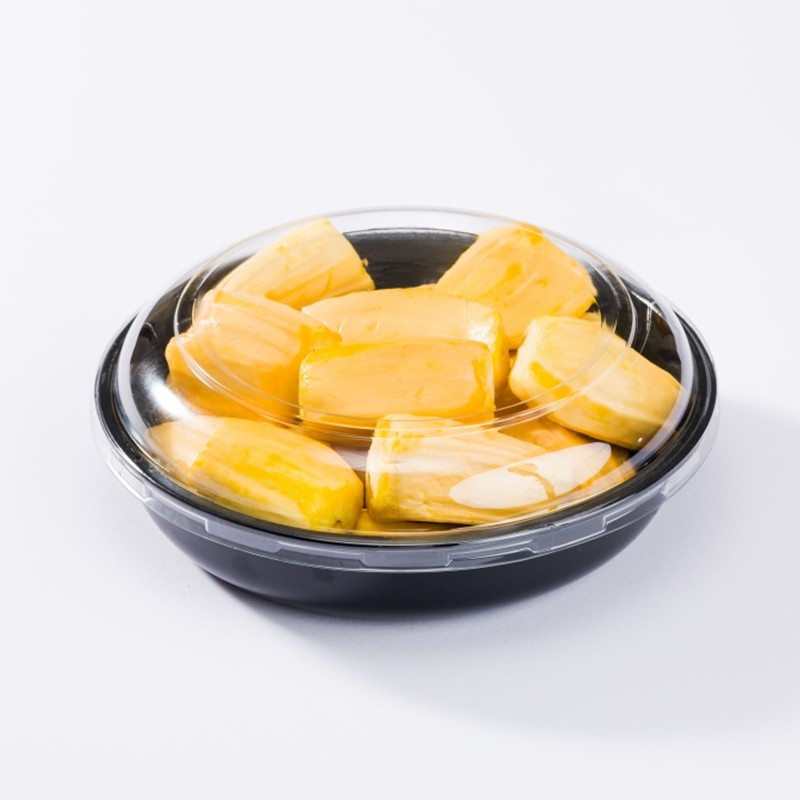
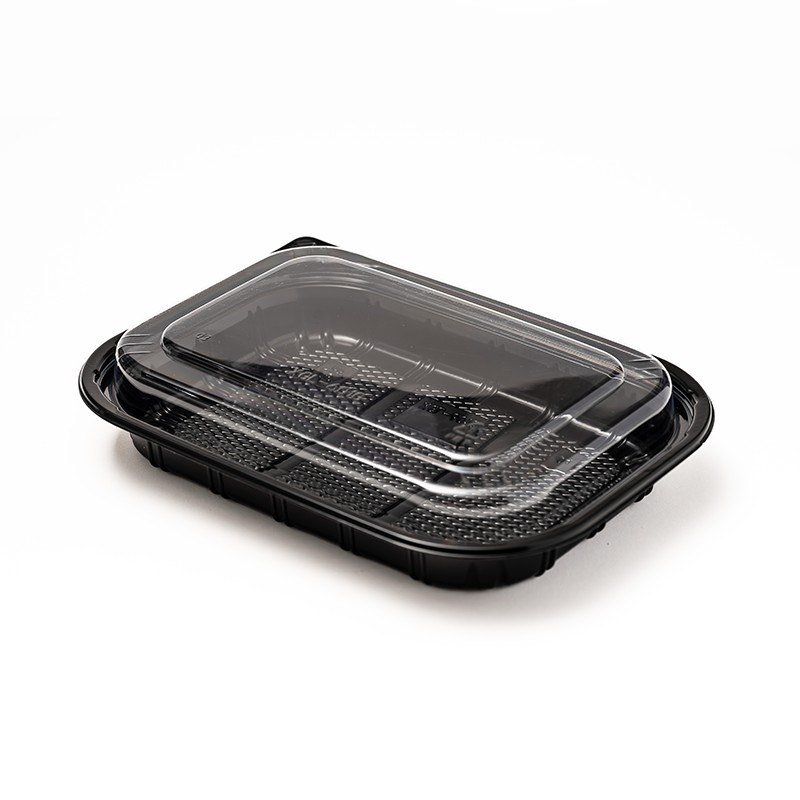 XGL-315 Black Anti-Fog Deli Tray With Clear LidTwo-part deli tray with anti-fog clear lid and snap-fit PP base, practical for refrigerated display and repeated opening rather than gas-control sealing.View Product →
Validating a Sealed Tray in Five Steps
Most sealing problems can be caught before the first production run, provided the trial is structured rather than improvised. This sequence is the one that consistently works.
Define the product, the target shelf life, and the gas mix before selecting a tray. The container follows from the requirement, not the other way around.
Match the container to the lidding film by seal layer chemistry first and thickness second. A film that seals beautifully on one flange profile can fail completely on another.
Run a temperature ladder. Seal at several temperature points, hold the sample for 24 hours, then test. Immediate testing flatters every seal.
Use dye penetration and burst testing rather than visual inspection. A seal that looks continuous can still leak at a rate the eye will never catch.
Verify at line level, from filling through palletizing. Seals that pass on a bench frequently fail once the pack meets real handling and real temperature swings.
Frequently Asked Questions
Are PETG heat seal containers food safe?
Yes, provided the resin and the lidding film are both rated for food contact. Ask for migration test data and a declaration of compliance, and confirm that the seal layer carries the same approval as the container body. A food-grade tray closed with an unapproved film is not a food-safe pack.
Can PETG containers go in the microwave?
Generally no. PETG softens at roughly 80 C, so the tray will distort before the food inside is properly reheated. If microwave reheating is part of the brief, specify a PP container instead and treat the PETG option as display and chilled distribution only.
Can sealed PETG trays be frozen?
They can, but PETG becomes more brittle as temperature drops. For frozen distribution, a PP base with a clear lid is usually the safer specification. If a sealed PETG pack is required, test it after at least one freeze-thaw cycle rather than at ambient temperature.
Can PETG trays run on an existing sealing machine?
Usually yes, because sealing equipment is generally flexible. The real constraint is tooling. You need a sealing die cut to the tray footprint and a film matched to that die, and most new formats require custom tooling, which belongs in the lead time calculation.
If your question is not covered above, the broader food packaging FAQ covers compliance and material selection in more depth.
A sealed PETG tray is a chain of three decisions: the polymer, the film, and the sealing window. Buyers who treat it as a single part number almost always end up chasing leaks after the first production run. Buyers who treat it as a system, and validate it as one, get a pack that holds its atmosphere from the filling line to the shelf.