


 English

 Español
 中文简体
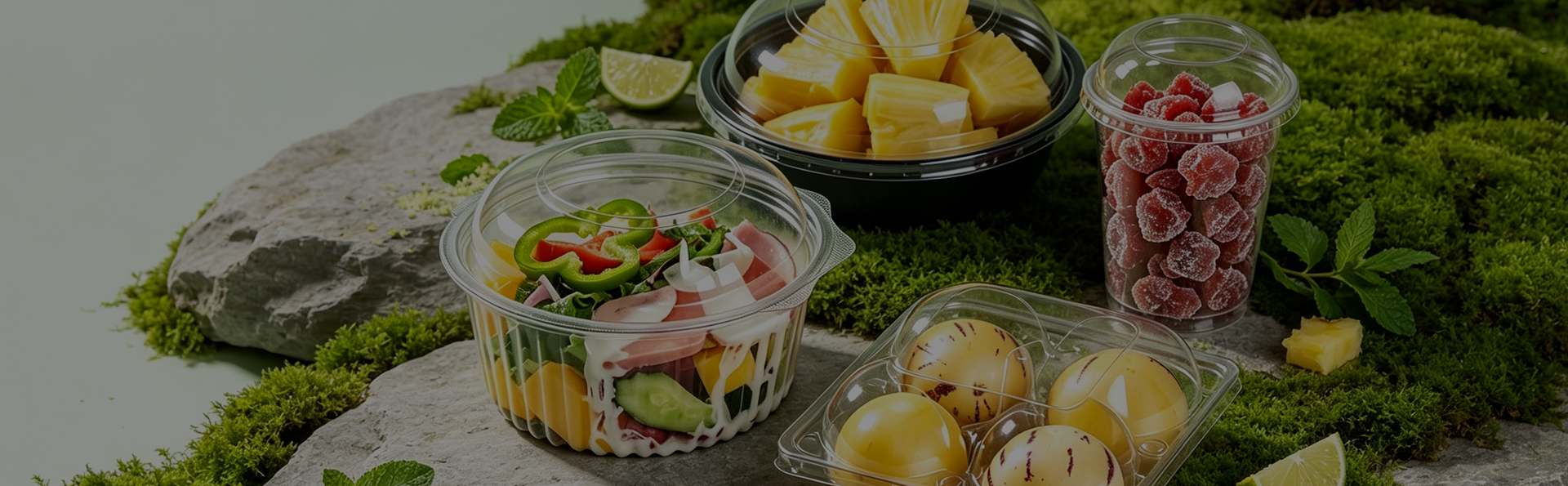

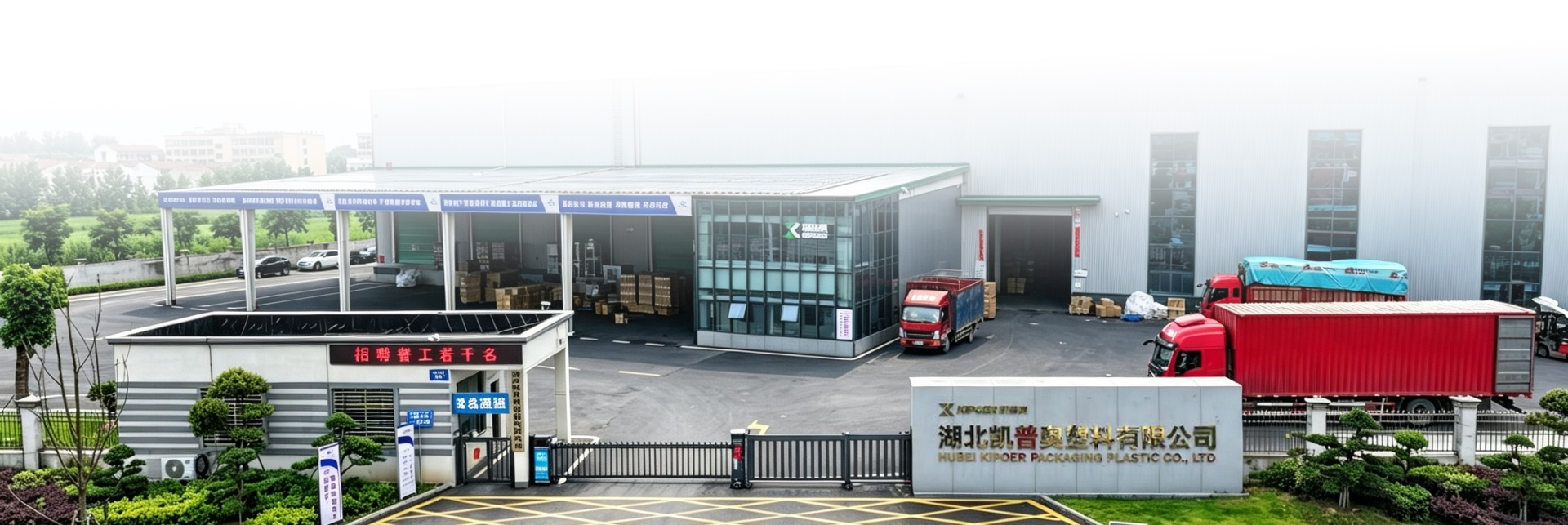



Hubei Kipoer Plastic Packaging Co., Ltd. manufactures round PET fruit containers with lids at our Xiaogan, Hubei production base, where PET and PP sheet extrusion, thermoforming, in-house mold making and cleanroom packing run under one roof. The round format is the display-oriented branch of our Round PET Fruit Container With Lid range: a separate base and lid, a wide fill opening, and a circular footprint that presents fresh-cut fruit, fruit salads and light ready-to-eat meals cleanly on shelf.
We supply these containers to fresh-cut fruit packers, supermarket fresh departments, catering and delivery kitchens, bakery and deli operations, and distributors who need a food-grade round container that holds its shape, seals reliably and shows the product through a clear lid. Standard stock formats cover common fill weights; custom molds cover the rest.
Round PET Plastic Fruit Containers manufacturer — Our Position in This Category
As a Round PET Plastic Fruit Containers Manufacturers, we match product configuration to the application, operating limits, interfaces and acceptance criteria defined for each project.
As a Round Plastic Fruit Containers manufacturer, we build the round family around one construction logic: a thermoformed PET base, a matching clear lid, and a rim profile that gives a consistent snap and stable stacking. Within that frame we vary diameter, depth, wall thickness, base colour, compartment count and lid style so the same tooling platform serves several pack sizes.
The round shape suits products that are sold by visual appeal — fruit slices, berry mixes, fruit salads, dressed salads and small ready-to-eat portions. A circular base also distributes load evenly, which helps when containers are stacked in a chilled display case or nested in an outer carton.
Our Round PET Container Range and Where Each Format Fits
We produce single-compartment and multi-compartment round bases in clear and black PET, with clear lids that can carry a flat label area. The two named formats below are current production items; the surrounding rows describe the configuration options we build to order.
| Configuration | Base | Lid | Typical fill | Where it fits |
|---|---|---|---|---|
| Single-compartment round container | Clear or black PET, smooth wall | Flat or domed clear PET lid | One fruit variety, slices, berries | Supermarket fresh aisles, farm shops |
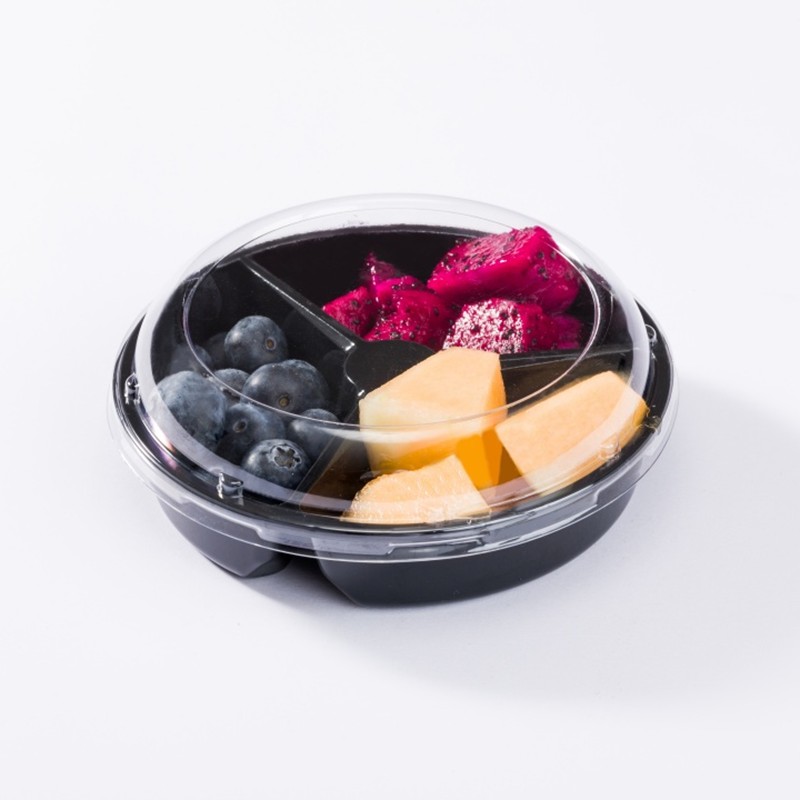
| Multi-compartment round container | Black or clear PET with 2–4 dividers | Clear PET lid, optional label area | Mixed fresh-cut fruit, snack mixes | Convenience retail, delivery menus |
| XGL-160 three-compartment round container | Black PET base, three compartments, label area | Clear lid | Fresh-cut fruit trio | Grab-and-go, branded display |
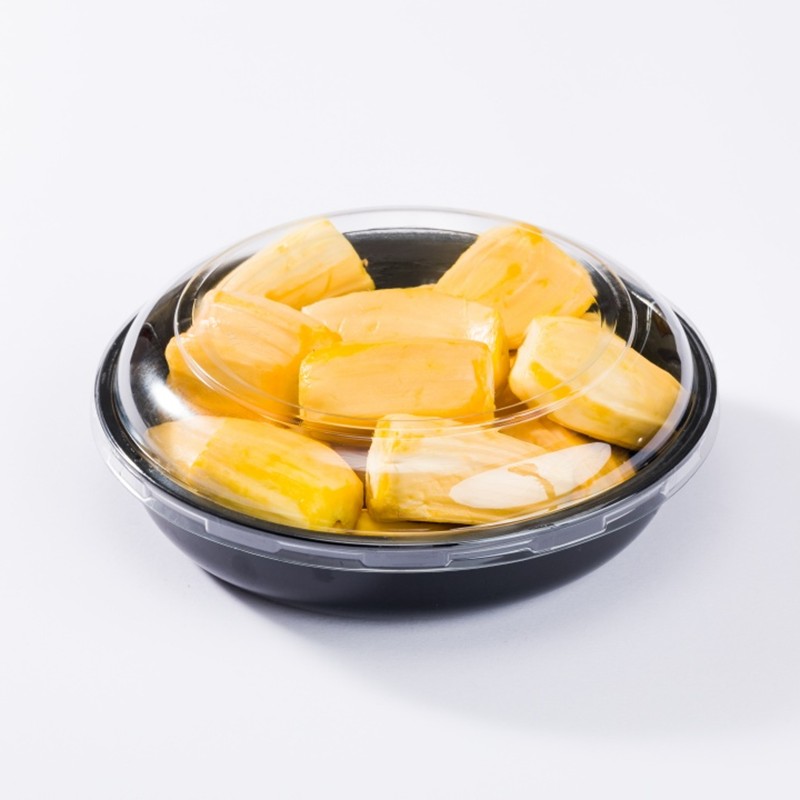
| XGL-190A round display container | Black PET base with label area | Clear lid | Fresh food display, fruit cups | Deli counters, chilled display cases |
| Round container with tight-sealing lid | PET base, deeper draw | Clear lid with close rim fit | Juicy fruit, dressed salads | Delivery, catering, ready-to-eat sections |
Adjacent formats in our catalogue cover buyers who need a different footprint for the same product: the Square PET Fruit Container With Lid gives more label face and tighter carton packing, while the Clear PET Fruit Clamshell Container range suits hinged, one-piece presentation.
Material, Construction and Critical Specifications
Bases and lids are thermoformed from food-grade PET sheet produced on our own extrusion lines, which keeps sheet thickness, clarity and forming behaviour consistent between production runs. Black PET bases are used where the packer wants fruit colour to read strongly against a dark background; clear bases are used where the product itself should be visible from every angle.
- Diameter and depth — set by fill weight, portion shape and the shelf or delivery tray the container must fit.
- Wall thickness — balanced against rigidity, lid snap force and material cost.
- Lid fit — rim geometry is the critical dimension; we verify seal behaviour on finished samples rather than on drawings alone.
- Stacking and nesting — base profile and lid shoulder determine how many units travel safely in an outer carton.
- Temperature resistance — checked on finished product in our testing laboratory for chilled and ambient distribution conditions.
Compartment Layout, Lid Options and Branding Area
Compartment count is usually the first decision after diameter. A single cavity suits one fruit type or a dressed salad; two to four cavities let a packer separate fruit varieties, keep wet and dry components apart, or hold a dip alongside the fruit. Dividers are formed into the base during thermoforming, so the layout is fixed at tooling stage.
Lid options follow the same logic. Flat clear lids give the best stack density and the largest printable or labelable surface; domed lids add headroom for taller fills. Where a label area is formed into the base or lid — as on the XGL-160 and XGL-190A — the packer gets a defined, flat zone for branding, batch coding or a nutrition panel without covering the product window.
Tooling, Customization and Mold Development
Customization is our core business. Our R&D team and mold workshop produce tooling directly from customer samples, product drawings or stated dimensions, and we support process adjustments including appearance, thickness, colour matching, anti-fog, anti-static and laminating. Round containers are well suited to this route because a single circular tool can be scaled in depth to create a family of pack sizes.
For buyers moving from a stock format to a branded pack, we typically run a trial forming before full production so that lid fit, wall thickness and stacking are confirmed on real parts. Small-batch trial orders and large long-term programmes are both handled on the same lines.
Production Capacity, Quality Control and Acceptance
Our production base runs 16 fully automatic high-speed vacuum forming lines with in-house mold processing and a Class 100,000 food dust-free clean workshop. Annual food thermoforming capacity exceeds 30,000 tons, with monthly output around 2,000 tons, which leaves scheduling headroom for peak-season fruit programmes.
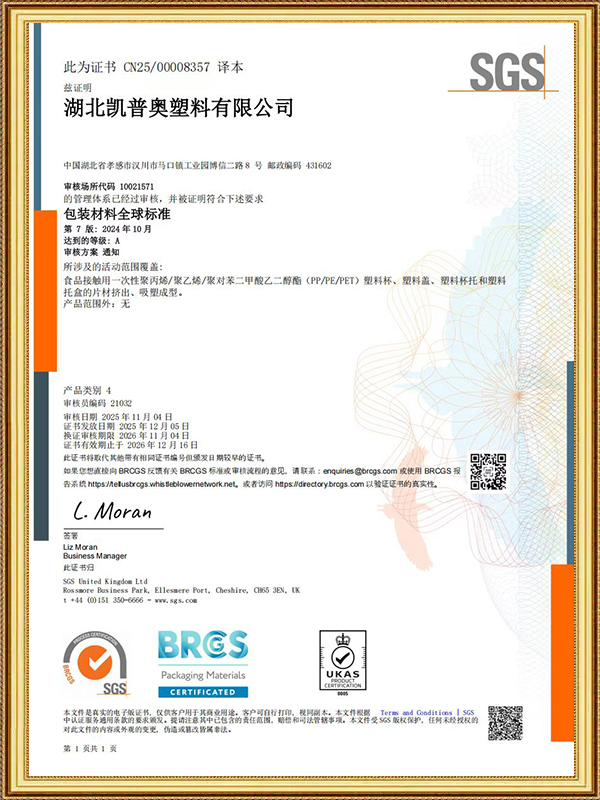
Quality control runs through the whole sequence. Raw material is checked for food-contact compliance before it enters the warehouse; production is dust-free and controlled with in-line inspection at each process step; finished containers are sampled for dimensions, sealing, temperature resistance and odour. Our laboratory is equipped with temperature resistance test boxes, sealing testers, thickness testers and food material safety testing equipment, and we issue third-party food contact test reports.
Information We Use to Configure Your Solution
A round container proposal is only accurate when it is built on the working point. These are the inputs our team needs to select a stock format or specify new tooling:
- Product to be packed, including whether it is wet, dressed, frozen or ambient
- Target fill weight or volume per container, and portion shape
- Required diameter, depth and compartment layout
- Base colour and lid type, plus any label area requirement
- Sealing expectation — transport, delivery, display or tamper indication
- Outer carton count, pallet pattern and stacking height
- Filling method: manual, semi-automatic or in-line sealing equipment
- Sample, drawing or reference container, where a custom mold is required
- Order pattern — trial quantity, repeat volume and seasonal peaks
Packing, Documentation and Delivery Scope
Round containers are nested or stacked according to wall thickness and lid geometry, then packed in export cartons sized to the pallet pattern agreed with the customer. Bases and lids are supplied as matched sets so that rim fit is not compromised by mixing production batches.
Documentation follows the order: material and food-contact test reports, carton and pallet specifications, and inspection records for the shipped batch. Our export sales team handles customs clearance alongside production, and enquiries received on a working day are answered with a quotation and technical response within 12 hours.
Frequently Asked Questions
What round PET fruit container sizes and compartment layouts can Kipoer supply?
We hold stock formats in clear and black PET with single or multiple compartments, and we build custom diameters, depths and divider layouts from customer samples, drawings or stated dimensions. Fill weight, portion shape and the display or delivery tray normally determine the final size.
Is the lid tight enough for dressed fruit salads and juicy fruit?
The round container uses a separate transparent lid with a close rim fit that seals tightly and helps preserve moisture and freshness. For high-liquid fills we confirm seal behaviour on finished samples with our sealing tester before production is released.
Can we apply our own brand to the container?
Yes. Several round formats include a formed label area on the base or lid, giving a flat zone for branding, batch codes or nutrition information without covering the product window. We also support colour matching and laminating as part of custom production.
What material is used, and is it food-contact compliant?
Containers are thermoformed from food-grade PET sheet produced on our own extrusion lines. Incoming raw material is checked for food-contact compliance before warehousing, and finished products are supported by third-party food contact test reports.
How much capacity is available for peak-season fruit programmes?
Our 16 fully automatic high-speed vacuum forming lines and Class 100,000 clean workshop give annual food thermoforming capacity above 30,000 tons, with monthly output around 2,000 tons. That leaves surplus for peak-season scheduling, and we handle both small trial batches and large long-term orders.
How do we start a custom round container project?
Send the product to be packed, target fill weight, required diameter and depth, compartment layout, base colour, lid preference and expected order volume, together with a sample or drawing if one exists. Our R&D and mold teams review the working point and return a configuration and quotation, normally within 12 hours on a working day.