

 English

 Español
 中文简体

Content
- 1 What Counts as a Disposable PP Plastic Food Container
- 2 PP, PET and PETG: Which Polymer Fits Which Application
- 3 Temperature Limits and Wall Structure Decide Whether a Tray Survives
- 4 Matching Container Format to the Food You Pack
- 5 Sourcing Checks Before You Sign the Purchase Order
- 6 Frequently Asked Questions
A chilled deli tray sits at 4 C for six hours, gets stacked eight high in a distribution centre, then spends three more days in a customer's refrigerator. The base has to hold its shape throughout, keep a clear lid sealed against condensation, and still cost less than the food inside it. That is the working brief behind almost every disposable PP plastic food container sold today.
Polypropylene earns that job for three practical reasons. It tolerates hot fill and microwave reheating far better than PET, it stays chemically inert against fats and proteins, and it thermoforms quickly enough that high-volume trays stay inexpensive. The trade-offs are real, though: natural PP is translucent rather than glass-clear, and standard homopolymer grades turn brittle in a freezer unless the resin is impact modified.
What Counts as a Disposable PP Plastic Food Container
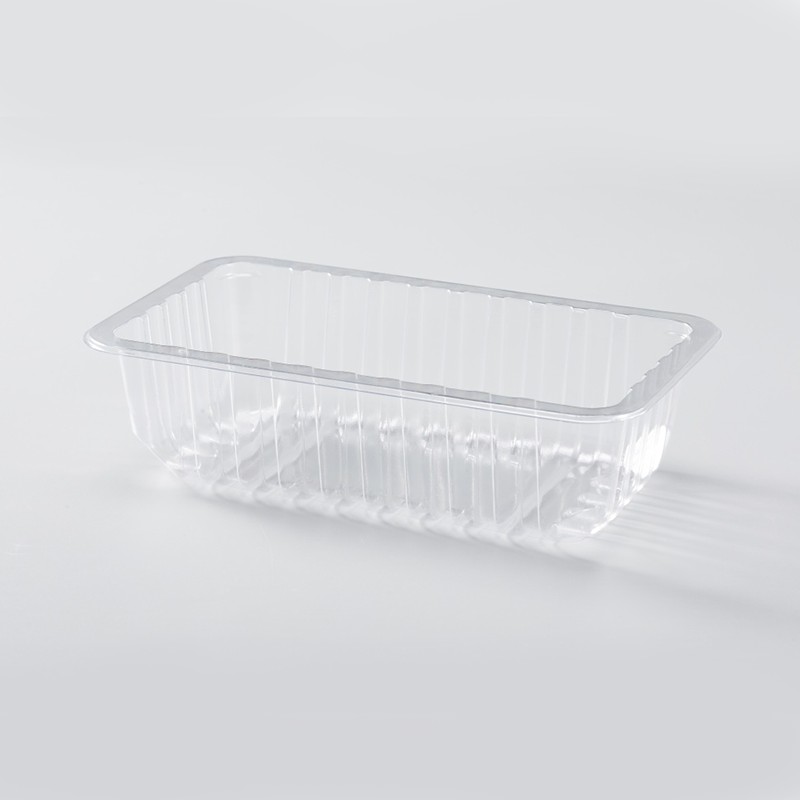
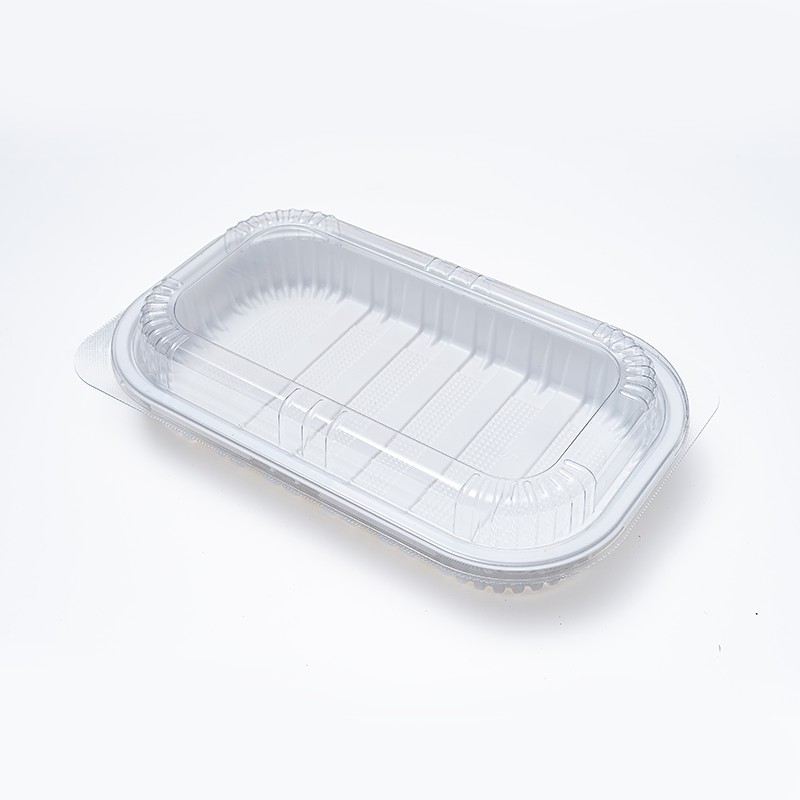
A disposable PP plastic food container is a single-use, food-contact package formed from polypropylene resin, supplied either as a base with a separate lid or as a one-piece clamshell, and intended for one fill-and-sell cycle rather than for reuse.
The category is defined by the resin, not the shape. PP deli trays with clear lids, frozen meat trays, takeaway bases, snack tubs and PP cup lids all belong to it, while visually similar PET trays do not.
Within that definition, the resin grade matters more than most buyers expect. Polypropylene is not one material but a family, and two grades that both read PP on a data sheet can behave very differently at -18 C.
- Homopolymer is the stiffest and most heat resistant option. It suits hot-fill deli bases and microwaveable takeaway containers, but it is also the most brittle in a freezer.
- Block copolymer keeps far more impact strength at low temperature, which is why it dominates frozen meat trays and chilled ready-meal bases.
- Impact-modified grades extend that further and are usually specified when a container must survive pallet drops below -20 C.
- Colour is a masterbatch decision rather than a resin property. Black, white and coloured trays use the same base polymer with different food-contact approved masterbatches.
Four variables decide whether a PP container performs as specified: wall thickness at the base and side wall, corner radius, the grade of resin, and the lid material. Everything else, including colour and print, is presentation.
PP, PET and PETG: Which Polymer Fits Which Application
PP wins on heat resistance and cost, PET wins on clarity, and PETG wins on sealing performance, so the right choice depends on which of those three you cannot compromise on.
| Property | PP | PET | PETG |
| Service temperature | -20 C to 120 C, grade dependent | -20 C to 70 C | -20 C to 65 C |
| Clarity | Translucent, opaque with masterbatch | High clarity | High clarity with a slight blue tint |
| Sealing | Heat seal with a PE layer, good for MAP | Snap lid, tamper evident options | Excellent heat seal and RF seal |
| Typical containers | Deli trays, frozen meat trays, takeaway bases | Fruit clamshells, cold cups | Heat-seal modified atmosphere containers |
| Resin code | 5 | 1 | 7 |
| Weak point | Cold brittleness without modifiers | Distortion above roughly 70 C | Higher cost and limited heat tolerance |
The commercial pairing that dominates chilled retail is a PP base with a clear PET or PETG lid. The base carries the fill weight and the heat history, the lid carries the merchandising. That split works because PP gives away clarity it never had, while the lid gives away heat resistance it rarely needs.
Bar length reflects the usable service window of each polymer, not a performance score. Grade choice, wall thickness and lid material can shift each range by 10 to 15 C in either direction.
Temperature Limits and Wall Structure Decide Whether a Tray Survives
Wall structure, not resin choice alone, decides whether a PP container comes out of a cold chain intact.
Two trays that look identical on a sample table can behave very differently on a pallet. A straight vertical wall with a sharp bottom corner concentrates stress exactly where frozen product expands; the same profile with a 2 to 3 mm corner radius and a ribbed base spreads that load across the whole footprint. Buyers who compare only grams per piece miss this, because the heavier tray is not automatically the stronger one.
Impact modifiers are the second lever. Standard homopolymer becomes brittle close to -10 C, and once a tray cracks at the corner the lid seal is gone and the whole pallet is at risk. Copolymer or impact-modified grades push that floor lower, which is why freezer programmes should never be sourced on resin price alone.
Test the failure mode, not the sample: fill the tray with a frozen block, stack ten high, hold at -18 C for 48 hours, then drop the stack from pallet height onto a hard floor. Cracks appear at corners and along the lid rim, which is exactly where they will appear in a customer's freezer.
For freezer and cold-chain programmes, the base usually needs anti-slip stacking lugs and a reinforced structure in addition to a cold-resistant grade.
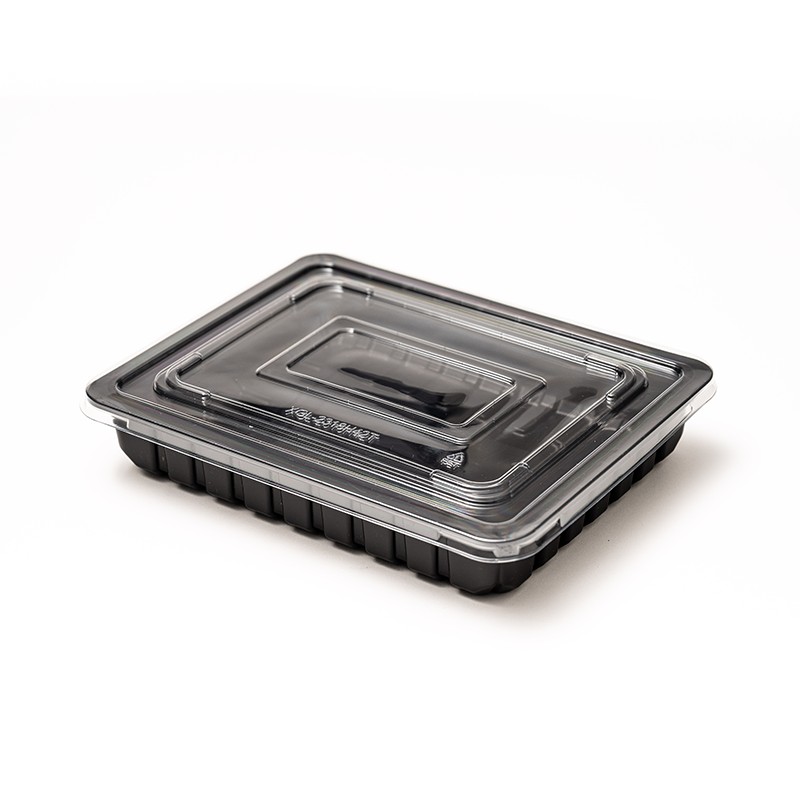
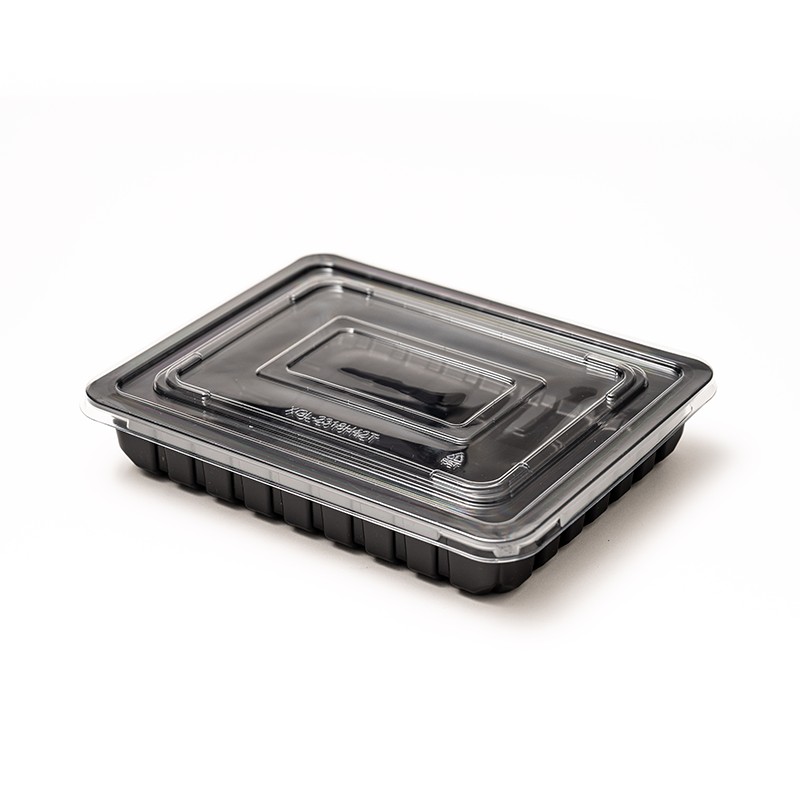 XGL-2318H42 Black Cold-Resistant PP Food Container with Clear PET LidSquare black PP base and anti-slip clear PET lid support cold-chain display; reinforcing ribs and textured lid help stacked packs stay stable.View Product →
Matching Container Format to the Food You Pack
Match the container to the display condition first and to the fill weight second, because a pack that looks wrong under lights will not sell regardless of how well it stacks.
Chilled and ambient display
- Anti-fog lids to control condensation
- Thin walls for fast chilling
- Vented or perforated options for produce
Frozen and cold chain
- Impact-modified base resin
- Anti-slip stacking lugs
- Reinforced corners and a thicker rim
Chilled deli and fresh-cut programmes live or die on condensation. An anti-fog additive on the lid surface makes water sheet away instead of forming droplets that obscure the product. It is one of the cheapest upgrades available, yet it is frequently left out of the purchase order because it never appears on a drawing.
A black anti-fog deli tray with a clear lid covers most chilled prepared-food cases, and the dark base hides scratching from repeated handling better than white or clear.
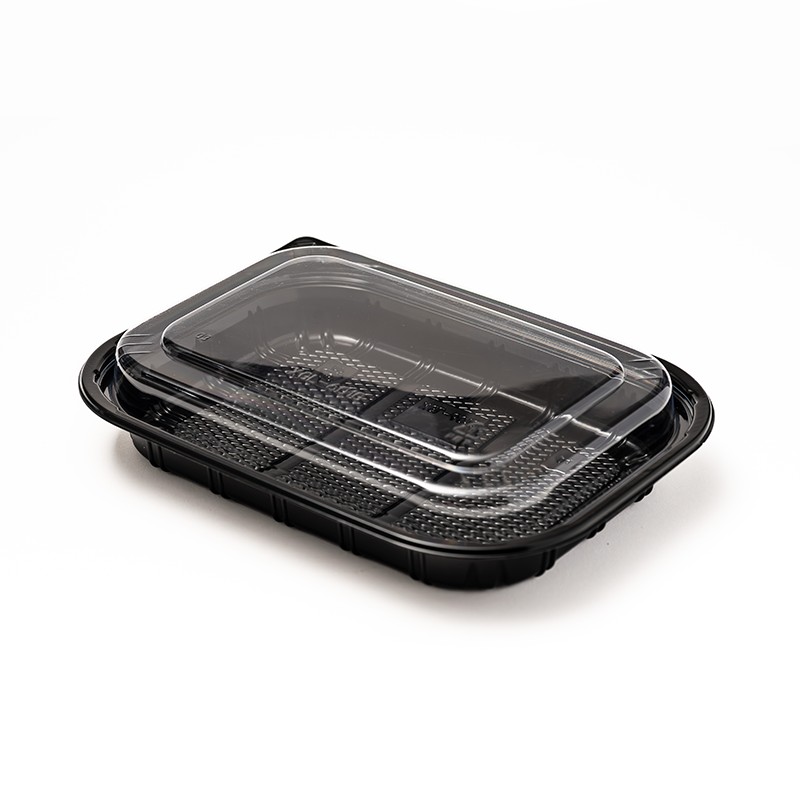 XGL-315 Black Anti-Fog Deli Tray with Clear PET LidBlack PP base and anti-fog PET lid keep deli food visible in chilled cases; snap-fit seal and recessed handle suit display and delivery.View Product →
Frozen meat and ready-meal programmes have the opposite problem. Product is packed warm, frozen hard, then handled by machines and staff at -18 C, so the base needs a cold-resistant grade, lugs that stop trays sliding when stacked, and a rim stiff enough to keep the lid seated through repeated handling.
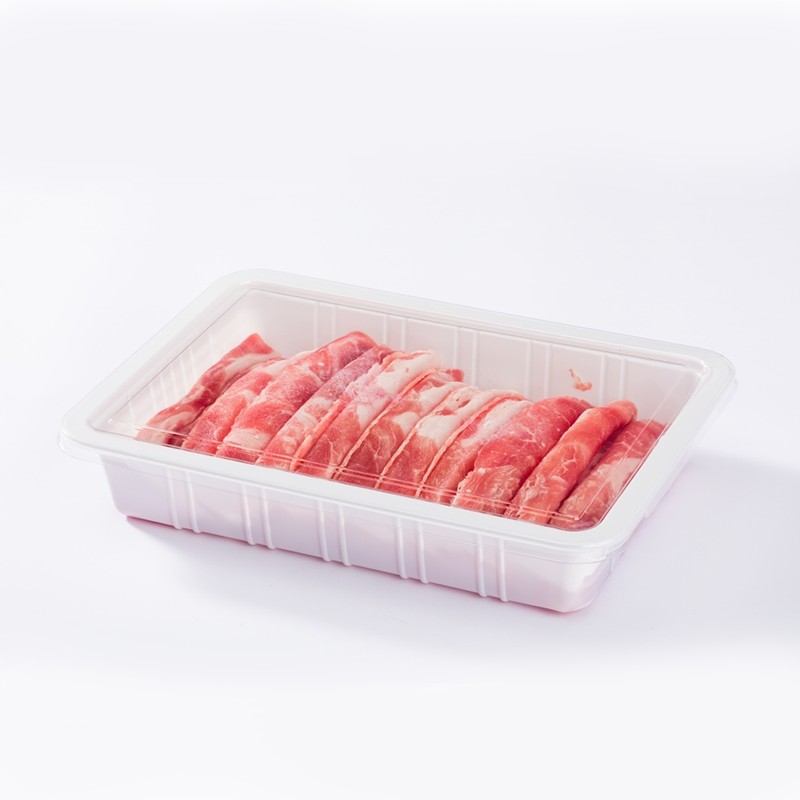
A white cold-resistant PP base with a clear PET lid is the standard answer for retail frozen meat, where the pale base makes fat and purge easier to inspect.
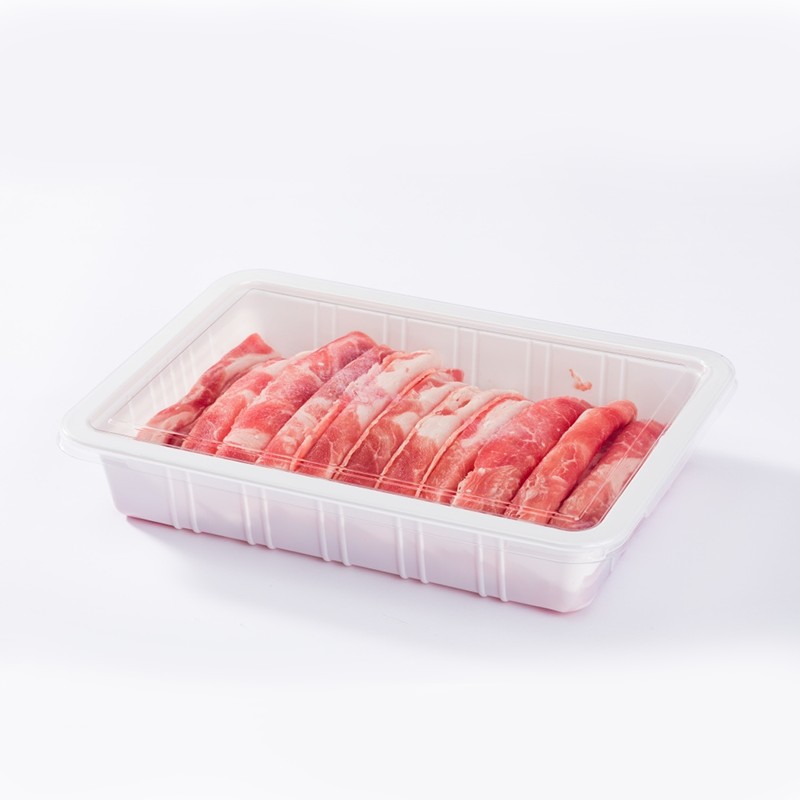 XGL-3118 White Cold-Resistant PP Frozen Meat Roll Container with Clear PET LidWhite PP base stays tough at -20°C and the clear PET lid lets shoppers inspect meat rolls without opening; outer-snap closure aids line sealing.View Product →
Specify the lid material separately. A PET lid gives clarity and stiffness but distorts above roughly 70 C, so it must come off before microwaving. A PP lid tolerates heat but reads milky. Mixed-material packs also need a clear disposal instruction, because the two parts belong to different recycling streams.
Sourcing Checks Before You Sign the Purchase Order
Five checks catch most PP container problems before the first pallet leaves the factory.
- Confirm the resin grade. Ask for the specific grade number and its matching food-contact declaration, not a certificate that only covers the polypropylene family.
- Measure wall thickness in three places. Base, side wall and rim behave differently, and thermoformed trays commonly run between 0.4 and 0.9 mm depending on format.
- Check rim flatness and lid fit. Leaks and condensation drips start at the rim, not the base, and rim flatness is measured in fractions of a millimetre.
- Test stack nesting and pallet pattern. Nesting height per tray decides carton count and freight cost, and an unstable stack shows up long before a customer complaint does.
- Verify anti-fog and venting in a real display case. A bench test at room temperature tells you nothing about how a lid behaves at 4 C and 85 percent humidity.
A certificate that covers the material family tells you nothing about the grade inside the tray you are buying. Ask for the grade number and the corresponding migration data, every time the supplier changes.
Wall thickness, rim flatness and lid tolerance interact, and a change in one usually forces a change in the others. Our tray specification guide walks through dimensions, formats and sourcing checks in more detail.
Frequently Asked Questions
Is a PP food container safe for microwave reheating?
Copolymer PP grades are typically rated for short-term exposure up to about 100 to 120 C, which covers reheating of moist foods. The base is usually fine; the lid is the part to check, and a PET lid should always be removed before heating.
Can disposable PP containers be recycled?
Yes. PP carries resin code 5 and is accepted in most rigid plastics streams. Two factors reduce recovery in practice: food residue that has not been rinsed out, and carbon-black masterbatch, which some near-infrared sorting systems cannot identify.
What is the difference between a PP deli tray and a PP frozen meat tray?
Both use a PP base, but the frozen version normally uses an impact-modified grade, a thicker rim, anti-slip stacking lugs and a base shape that releases frozen product cleanly. The deli version prioritises anti-fog lids and a thin wall for fast chilling.
Should the lid be PP or PET?
Choose PET when clarity drives the sale and the pack is never heated. Choose PP when the container goes into a microwave or a hot hold, or when single-material recycling matters more than transparency.
Kipoer has been thermoforming and moulding food-grade PET and PP containers since 2015, and the deli and freezer formats described here are standard production items rather than custom tooling projects. If you are weighing resin grades, wall thicknesses or lid combinations for a new listing, send the fill weight, the storage temperature and the display format, and the team can shortlist a base and lid combination before any tooling conversation starts. You can reach the packaging team through our contact page.