

 English

 Español
  中文简体
中文简体

Content
- 1 What a Clear PET Fruit Clamshell Actually Is
- 2 Sheet Gauge, Ribs and Resin: What Really Protects the Fruit
- 3 Venting, Hinges and Closure Types
- 4 What to Fix in Writing Before You Order
- 5 Tamper Evidence, Labeling and Line Handling
- 6 Recycling Reality and Supplier Checks
- 7 Frequently Asked Questions About Clear PET Fruit Clamshells
A hinge that splits on a 4.4 oz berry clamshell costs a packer far more than the fruit inside it, and the failure almost never shows up at the filling line. It appears three days later, in a chilled display, under a stack of cases, with a lid that no longer snaps shut.
Clear PET fruit clamshells look simple: two formed halves, one hinge, one closure. The purchasing decisions behind them are not. Gauge, vent pattern, hinge radius and closure type all interact, and changing any one of them can move a pack from running clean at 60 per minute to one reject in forty.
What a Clear PET Fruit Clamshell Actually Is
A clear PET fruit clamshell is a one-piece thermoformed container made from food-grade polyethylene terephthalate sheet with resin identification code 1, in which two formed halves are joined by an integral living hinge and held closed by a snap tab, press-fit rim or tamper-evident latch.
Three properties define the category: the material is PET sheet rather than PP, PVC or moulded pulp; the body is thermoformed as a single piece with no separate lid; and the pack is designed to hold fresh produce in chilled display while staying transparent enough for the fruit to sell itself.
Because there is no separate lid, the hinge and the closure carry the entire structural job. Two clamshells formed from the same sheet can therefore behave very differently on your line, because the difference sits in geometry rather than in material cost.
Typical applications include blueberries, strawberries, cherry tomatoes, grapes, kiwi and cut fruit. Most buyers move to clamshells from a punnet-and-film format because the pack needs a flat printable top face, a stable stacking footprint or a visible tamper seal.
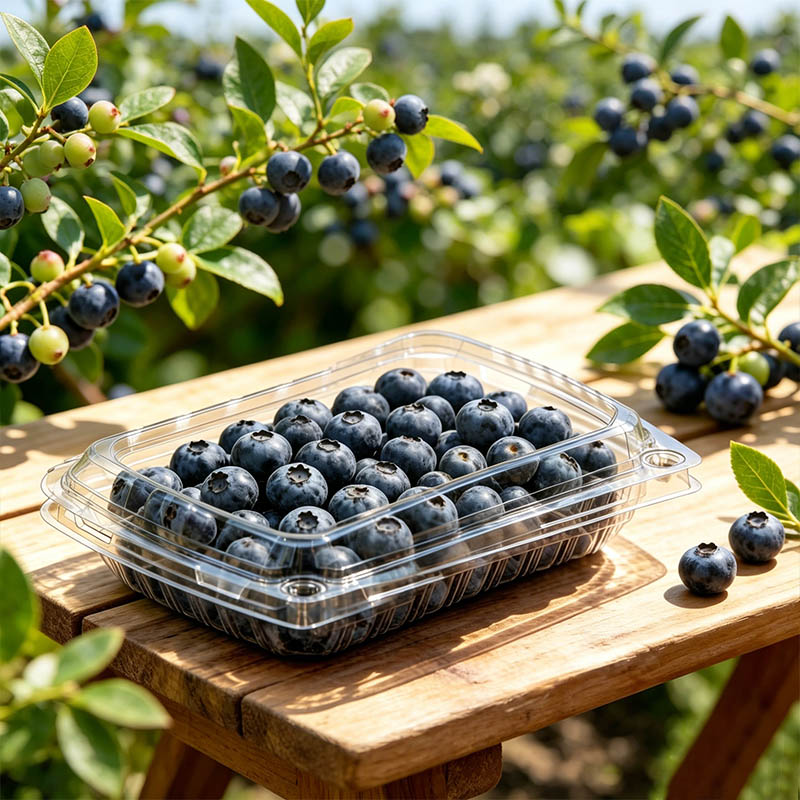 Clear PET Fruit Clamshell Container SeriesA transparent hinged PET range for berries, tomatoes, grapes and cut fruit, with ventilation, stacking and tamper-evident options to match retail pack formats.View Product →
Sheet Gauge, Ribs and Resin: What Really Protects the Fruit
Sheet gauge and rib geometry decide whether a clamshell survives distribution, while resin grade decides whether it stays clear and crack-resistant at chilled temperatures.
Gauge is the most over-specified number in fruit packaging. A 0.70 mm clamshell is not automatically stronger than a 0.50 mm one, because stiffness comes from rib depth, corner radius and flange width as much as from wall thickness. Over-thick walls also raise resin cost per pack and can make the snap harder to close at line speed.
Resin choice matters at low temperature. Standard amorphous PET delivers the clarity buyers expect in a retail case. Crystallised PET, usually called CPET, tolerates higher heat but is opaque, so it belongs in ovenable formats rather than in a see-through berry pack.
Practical rule from the line: fix the hinge radius before you fix the gauge. A 0.50 mm pack with a generously radiused hinge and a reinforced rim typically outperforms a 0.70 mm pack with a sharp hinge corner in a 1.2 m drop test.
Venting, Hinges and Closure Types
Vent holes, hinge geometry and closure type have to match how fast the fruit respires, because sealing a respiring berry in an unvented clamshell fogs the walls and softens the fruit within days.
Berries and cherry tomatoes lose water and release field heat. If that moisture cannot leave the pack, it condenses on the inside walls, hides the fruit from shoppers and creates a wet surface that shortens shelf life.
Vented clamshell
- Drains condensation from the walls
- Supports faster pre-cooling
- Best for blueberries and long transit
- Slightly lower structural rigidity
Unvented press-fit
- Higher rigidity for taller stacks
- Cleaner top face for labels
- Suits cut fruit and salads
- Fogging risk without a film barrier
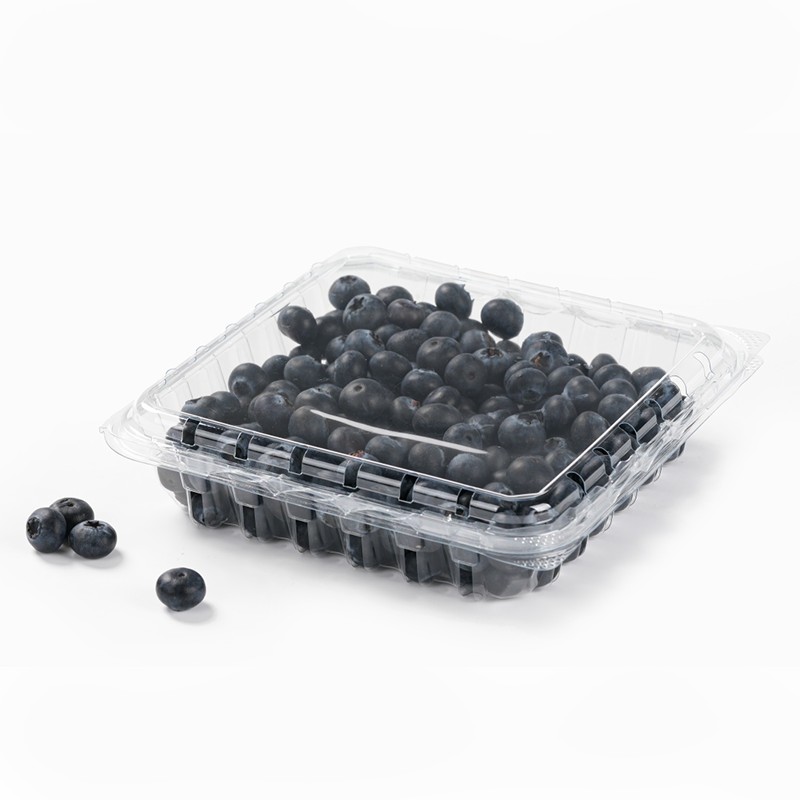
Blueberry programs usually want the vented version with a positive latch, so the lid stays closed through a pallet stack while moisture still escapes.
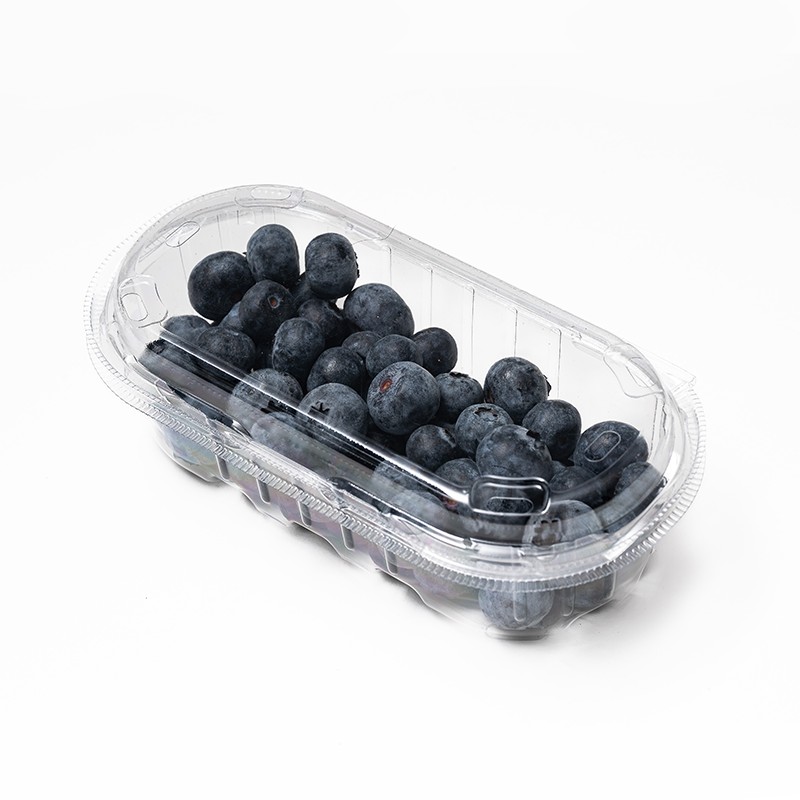 XGL-200 Vented PET Blueberry Clamshell ContainerHigh-clarity vented PET pack for blueberries, with lid and base airflow holes plus sunken-corner stacking to support stable retail displays and moisture control.View Product →
What to Fix in Writing Before You Order
Before a purchase order is signed, six values should be locked in writing: sheet gauge, outer dimensions, closure type, vent pattern, resin grade and stack load.
- Approve a dimensioned drawing with tolerances instead of a product photograph.
- Cut a sample from the production cavity and measure gauge at the flange, the wall and the hinge.
- Fill and close 200 units, by hand and by machine, and record the reject count.
- Chill the filled packs to your real display temperature, then stack them to your real case height.
- Write the resin grade and any recycled content percentage into the specification.
- Agree packing method, case count and nest direction so the denester feeds cleanly.
| Parameter | What to fix in writing | Why it matters |
| Sheet gauge | 0.45 to 0.55 mm for standard berry packs | Thin walls crack at the hinge; thick walls add resin cost without adding strength |
| Outer dimensions | Length, width, height, plus or minus 0.5 mm on the flange | Case count, tray footprint and lid clearance all depend on it |
| Closure type | Snap tab, press-fit rim or break-away tamper latch | Sets opening force in store and behavior under stacking |
| Vent pattern | Hole diameter and count per half | Controls condensation, fogging and firmness in the cold chain |
| Resin grade | Virgin food-grade PET, or a stated recycled content percentage | Clarity, food-contact declarations and drop performance change with grade |
| Stack load | Filled units per case and cases per pallet layer | Determines whether the rim needs reinforcement |
Thermoformed tolerances are usually quoted as about plus or minus 0.5 mm on the flange and 2 percent on overall length. If your case count depends on a tight fit, ask for measured cavity data rather than the nominal drawing.
Tamper Evidence, Labeling and Line Handling
Tamper evidence is a retail requirement rather than a design flourish, because a snap tab that a shopper can open in the aisle is also one that can be opened, tasted and reclosed.
Tamper evidence
A break-away latch that tears visibly on first opening. Check that it still closes after the tear.
Labeling
Keep the top face flat for print and barcodes, and never lay a label across vent holes.
Line handling
Denesting, static buildup, hinge opening and closing pressure decide your reject rate.
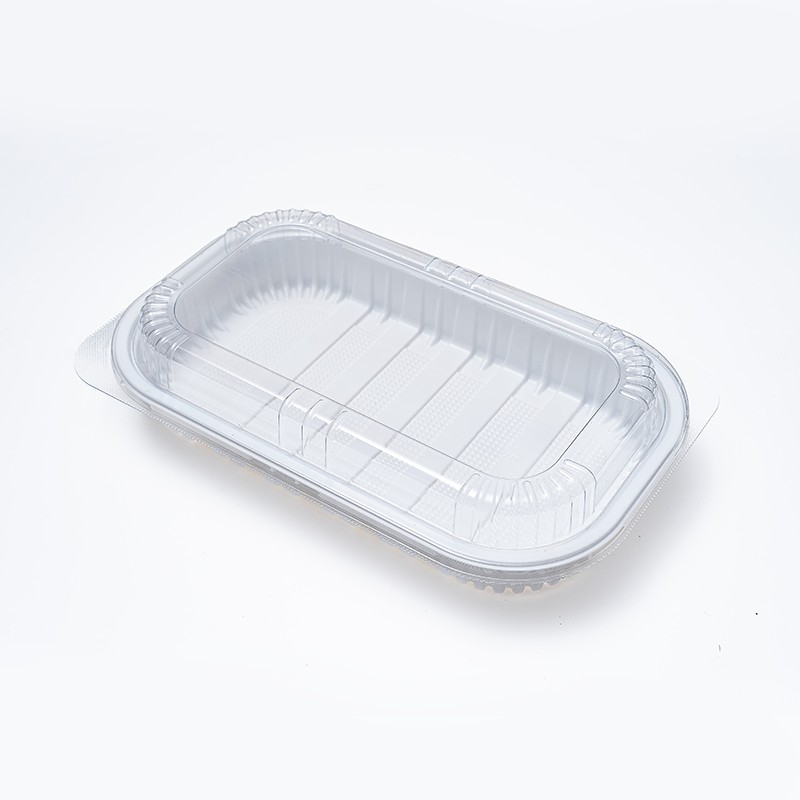
Where an open-and-reclose pack is a genuine risk, a rectangular tamper-evident clamshell gives the retail audit a visible seal without adding a sleeve or a shrink band.
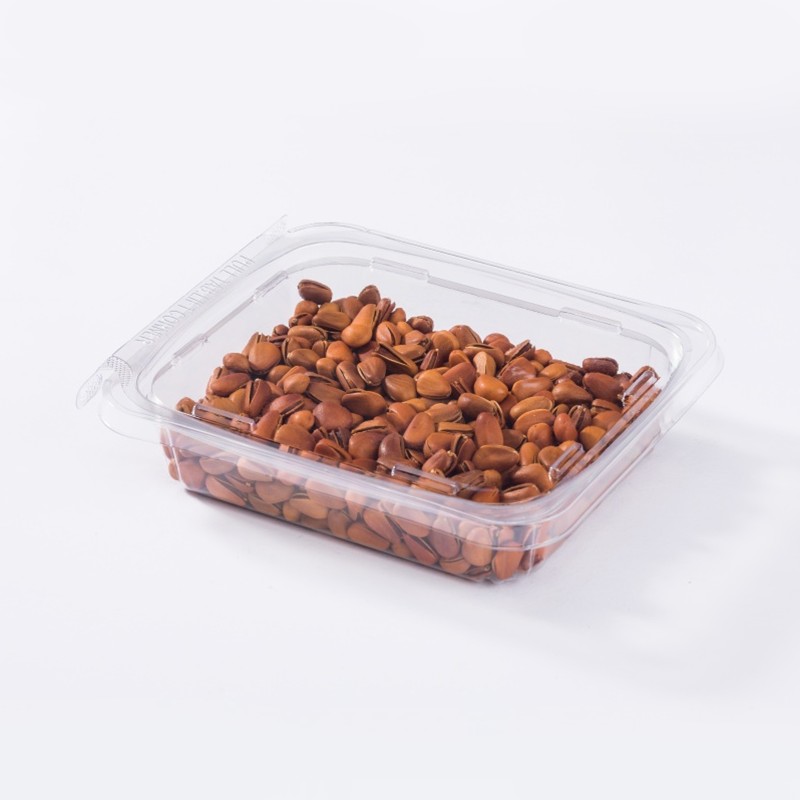 XGL-00140 Tamper-Evident Rectangular PET Fruit ClamshellRectangular PET clamshell with inner-snap tamper evidence and tear-line opening, suited to retail fruit packs needing visible first-opening security and consistent heights.View Product →
Two checks catch most retail complaints before they happen: open and close twenty packs by hand and record how the latch feels, then run a 24 hour chill-and-stack test at your real case height.
Recycling Reality and Supplier Checks
Clear PET clamshells carry resin code 1 and can be recycled, but only where the local program accepts thermoformed PET, and a growing number do while many still reject it.
The obstacle is rarely the polymer. It is shape and contamination: flat thermoformed packs screen out in sorting equipment, and juice or pulp left on the walls pushes a whole bale into residue. Bottles and clamshells share the same code but not always the same recovery route.
- Specify mono-material PET with no PVC labels or PE hinge inserts.
- State any recycled content target clearly, then confirm it against clarity and drop performance.
- Print the resin code and material on the flange for sorters and store staff.
- Keep food residue out of the pack before it reaches a collection point.
Supplier capability matters more than catalogue depth here, because gauge control and hinge geometry come from the forming line. A thermoforming operation that runs PET and PP in-house can hold those values in ways a trading company cannot, so it is worth reading the manufacturer profile and factory documentation before you compare quotations.
Recycled content is a specification, not a slogan. If a retailer asks for 30 percent post-consumer PET, ask what that does to light transmission, hinge strength and drop performance before the change is written onto the drawing.
Frequently Asked Questions About Clear PET Fruit Clamshells
Short answers to the four questions buyers ask most often before a first order of clear PET fruit clamshells.
Are clear PET clamshells recyclable?
Yes in material terms, because PET is resin code 1 and is widely reprocessed. In practice, acceptance depends on whether your local program collects thermoformed PET, and on whether the pack reaches the sorter clean and empty. Always confirm with the program that serves your retail region rather than with the resin code alone.
What sheet gauge should I choose for blueberries and strawberries?
Most 1 lb berry packs sit between 0.45 and 0.55 mm. Blueberries stacked deeper than six cases often justify 0.60 mm or a reinforced rim, while a light 4 oz strawberry pack can run closer to 0.40 mm. Gauge should follow stack load and transit distance, not habit.
Can clear PET clamshells take warm or hot filling?
Amorphous PET softens well below hot-fill temperatures, so it suits chilled and ambient fruit rather than hot products. If the application needs heat tolerance, the material normally shifts to CPET or PP, and transparency is lost in the process.
How do I compare two clamshell suppliers fairly?
Compare measured gauge and cavity data, not price per thousand. Ask each supplier for a filled sample at your real stack height, a dimensional report and a food-contact declaration, then run both on the same line for a week. The fastest way to settle a gauge argument is to request formed samples in two thicknesses and test both yourself.